



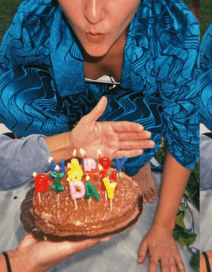


Grandma’s Recipe
My famous apple pie recipe, a staple at every family gathering. First, we start with the crust—two and a half cups of all-purpose flour, a teaspoon of salt, and a tablespoon of sugar mixed with a cup of chilled butter. I remember the sound of the rolling pin across my countertop, echoing the rhythm of generations past. Next, the filling—six crisp apples, peeled and sliced, tossed with half a cup of sugar, a teaspoon of cinnamon, and a pinch of nutmeg. As I write, I recall my grandchildren sneaking slices of apple from the bowl, their giggles filling the room. Bake until golden brown, about 50 minutes, and let it cool before serving. Each bite carries the warmth and love of our family, preserved within these cherished pages."
Kai
Eden
Martin


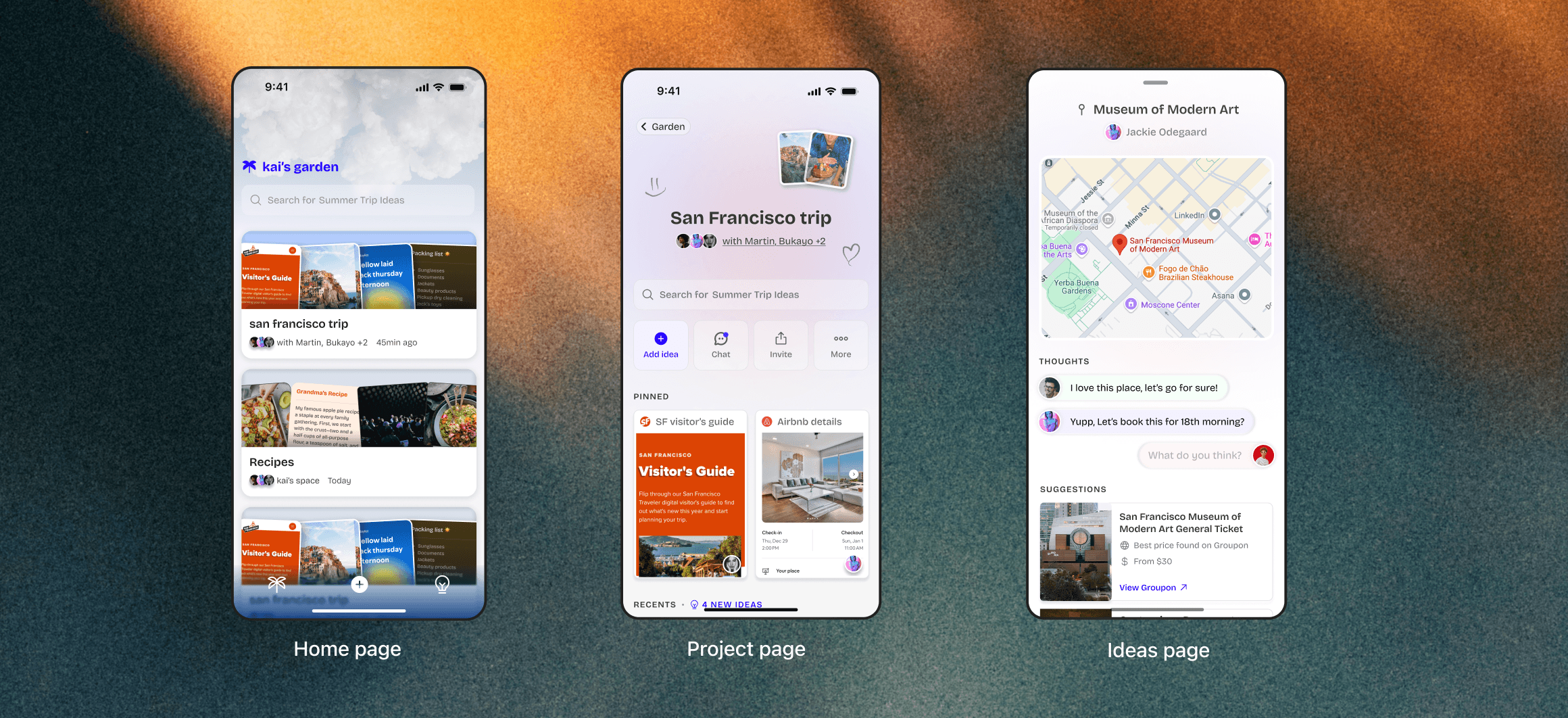
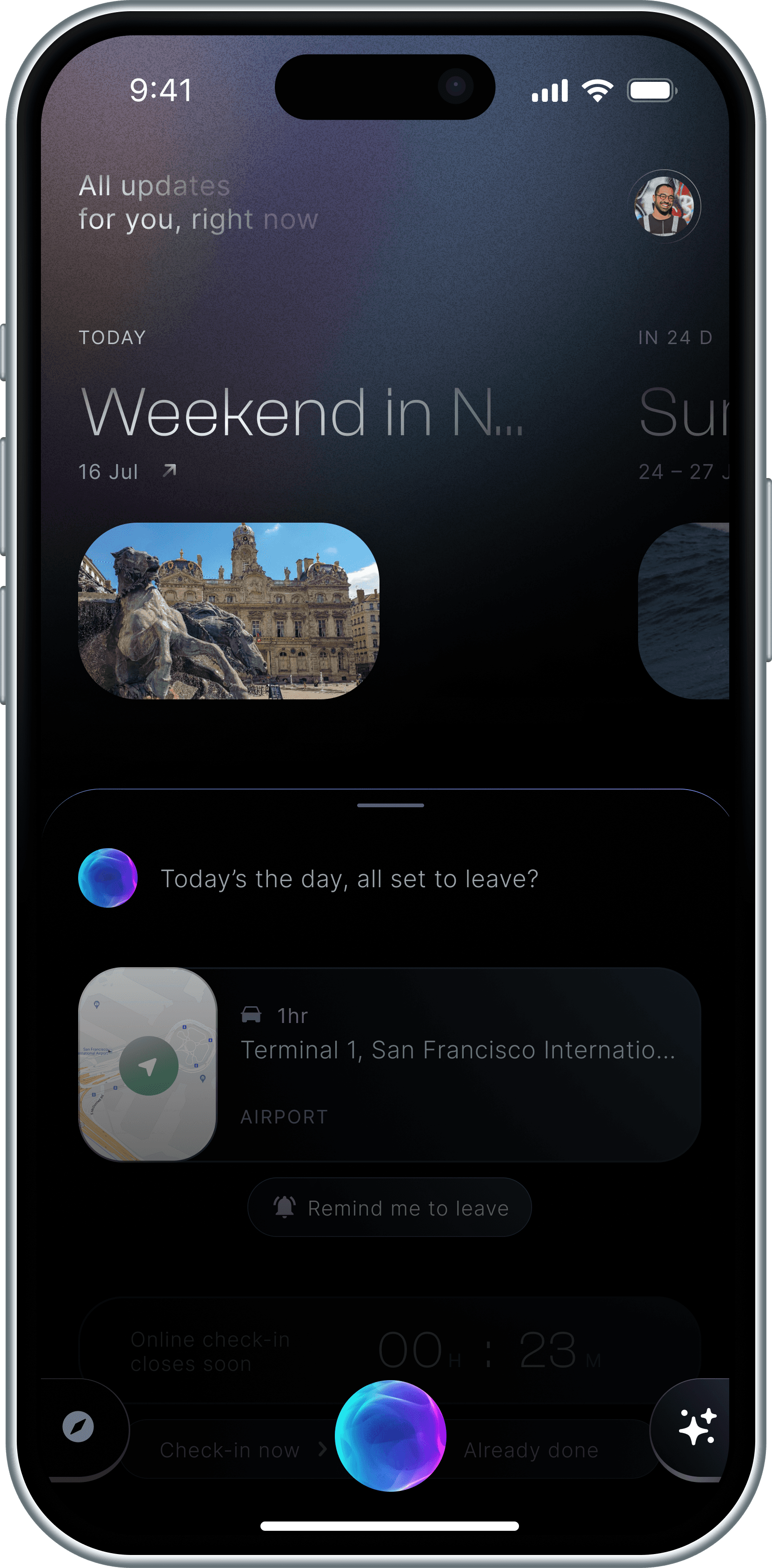
San Francisco trip


with Martin, Bukayo +2
Role
Product Design — Human interface design, Interaction design, Research, Product strategy, Art direction
Team
Solo project
Timeline
2 months, Apr - May ‘25
Overview
I developed Eden as an academic exploration into personal knowledge and sensemaking. Through research, conceptual modeling, and interface design, the project investigates how ideas become siloed across platforms and why existing tools fail to support action.
Eden reframes saving as an interpretive process, using context, time, and patterns of behavior to organize ideas around intent and future use.

The problem


Instagram saved
42 items
Food spots
Packing lists
Guide to Angor Wat
LLM Chats
137 items


Pins saved
32 items
Food spots
To do - 3/04/25
Ideas again

Notes
23 items


Screenshots
1290 items
Do you see a problem here?
Ideas today are captured everywhere — Instagram, Pinterest, messages, notes, screenshots.
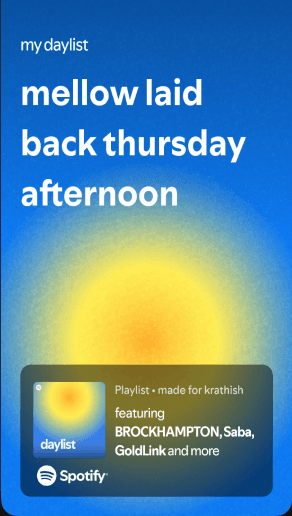
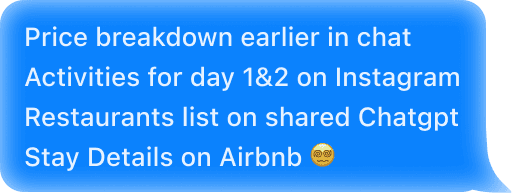
Each platform stores ideas in 🔒 isolation, based on where they were found, not how they’ll be used.
Ideas stay as inspiration instead of becoming experiments, projects, or decisions.
Saved ideas graveyard

Everything you ever wanted
Idea silos


Introducing Eden


Capture ideas where you find them and save them where you will use them

Eden understands why you save something, in context

Connect related ideas across apps

Eden organizes and surfaces ideas at the project level

Verdict

Staff Product Designer, Meta
“
Eden showcases the capabilities and limitations of our current app ecosystem. ‘Idea silos’ is a standout phrase, and the way you propose breaking them made us think deeply”

Principal PD, Zoc Doc
“
This is Steve Jobs–level thinking. The moment you talked about screenshots with links, it instantly clicked—I knew I needed this.”
Product Manager, Amazon Music
“
In a world obsessed with productivity, this tackles a deeper problem: how we organize ideas. It clearly separates thinking from doing—and wraps it in a visual language that feels alive, colorful, and inspiring.”

Process
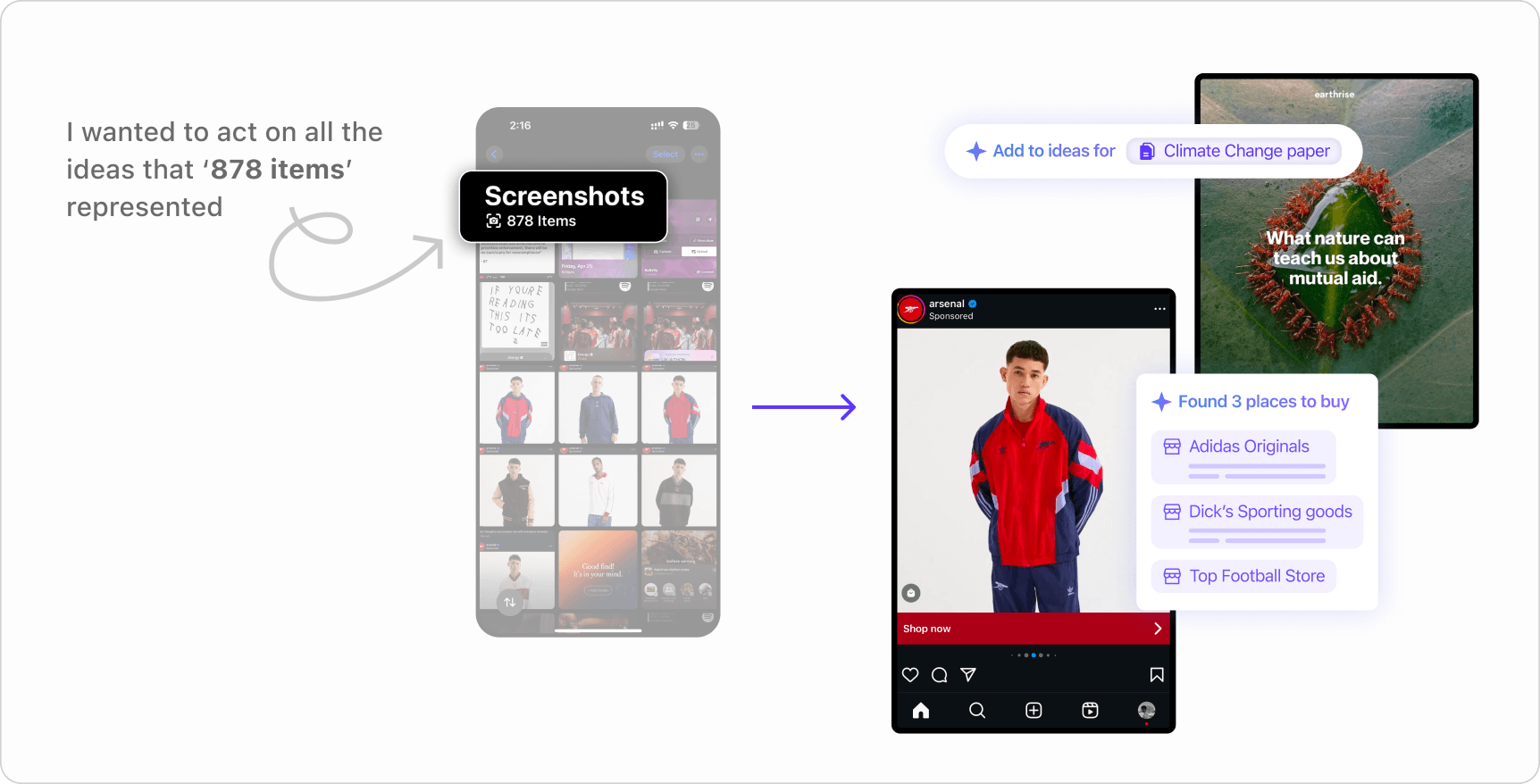
It began with cluttered screenshot galleries—ideas saved with intent, but quickly forgotten.

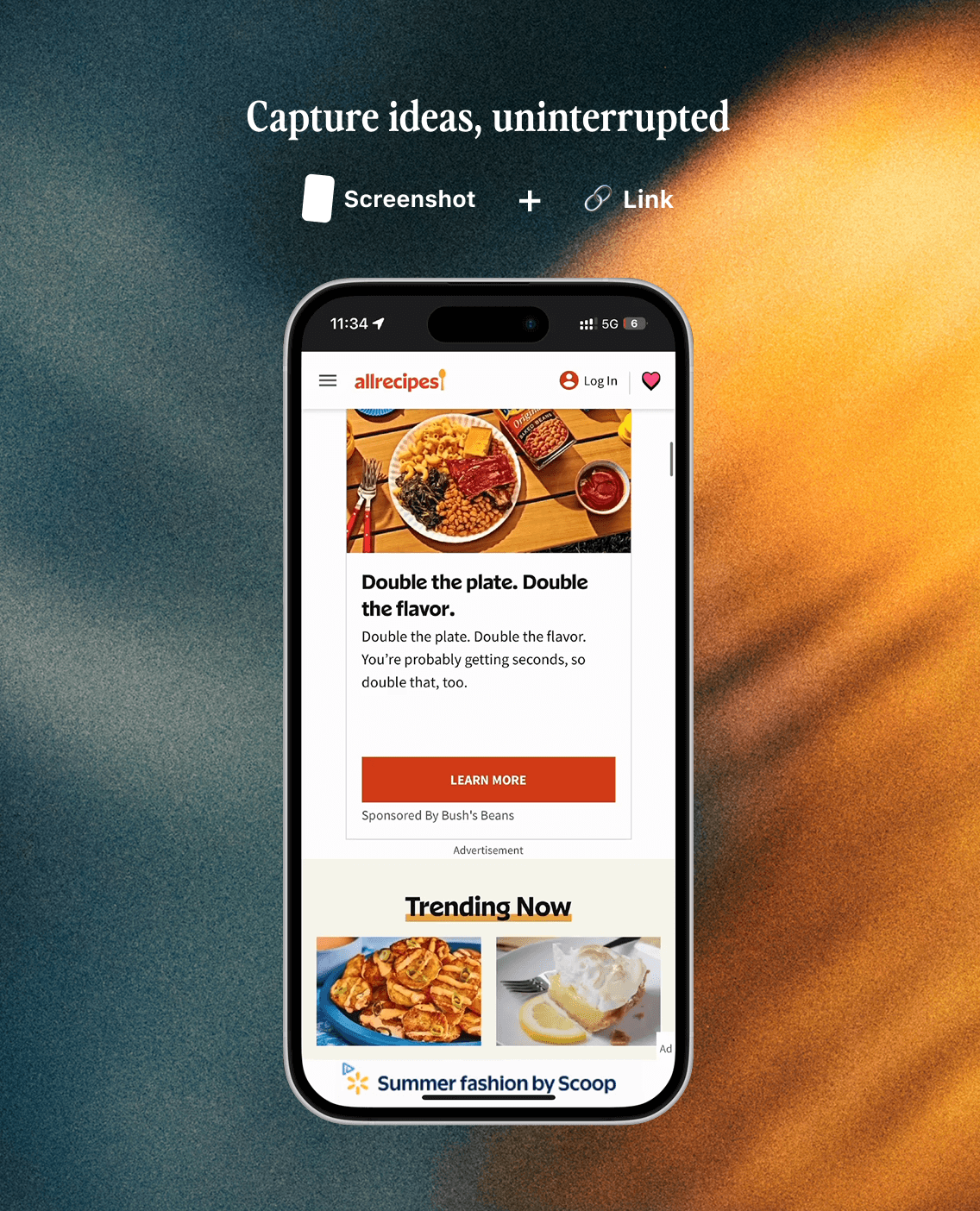
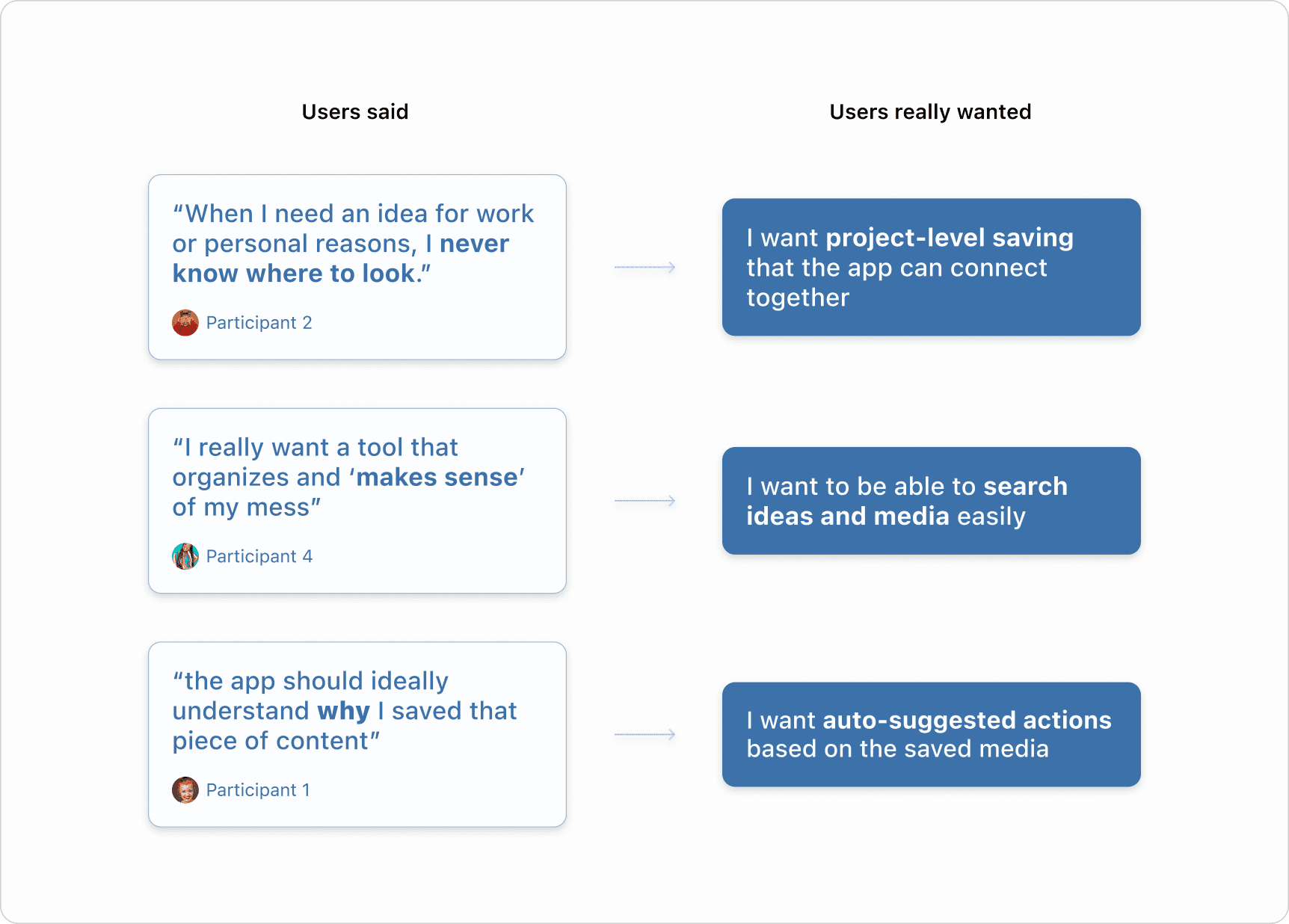
People were collecting inspiration from everywhere, yet nothing was connected or easy to return to. I thought the solution was making screenshots more actionable (seen below). After interviewing users, I learnt that what we really want isn’t more saving, but a system that understands why something was saved and helps turn it into action.

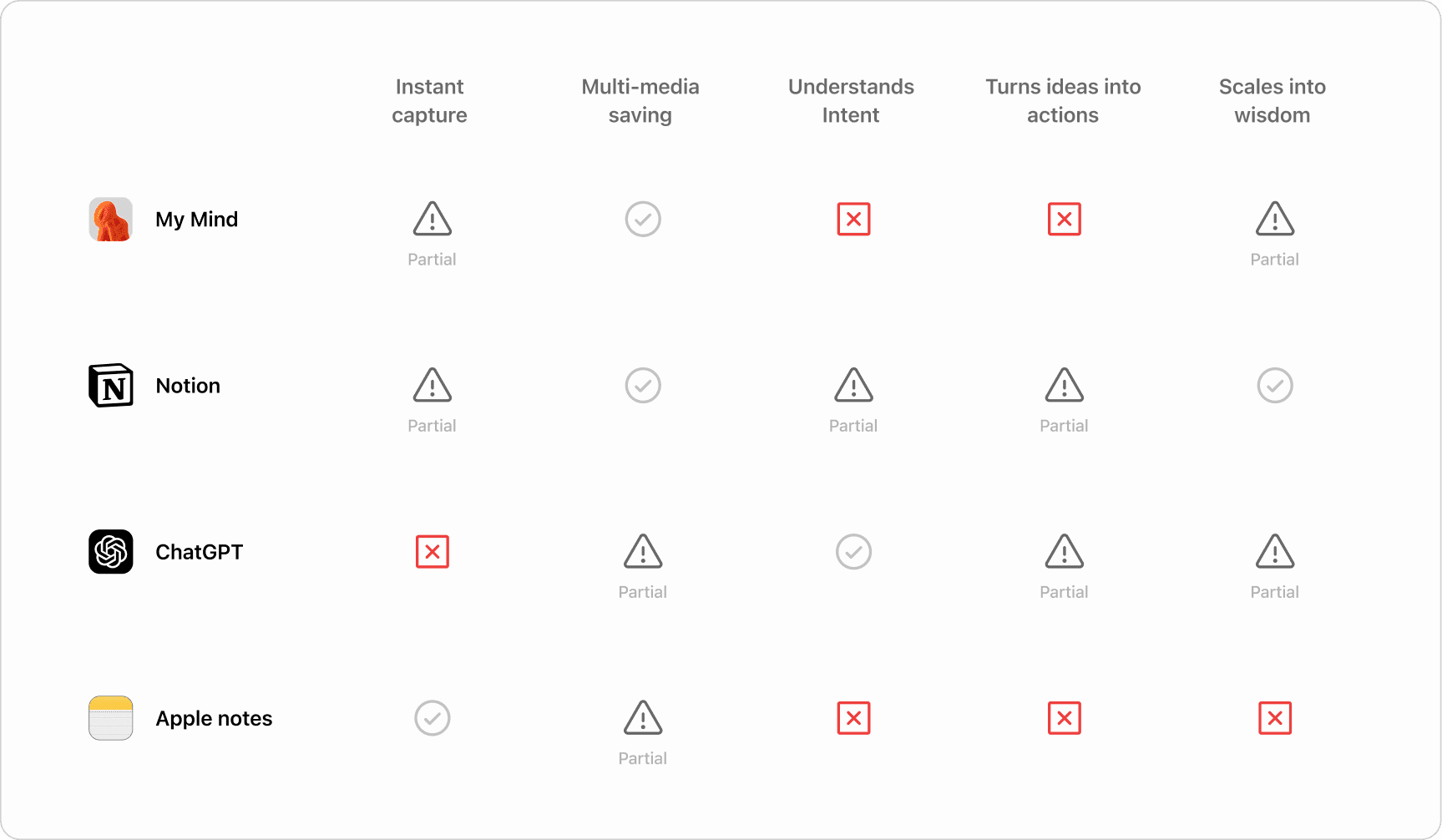
What was missing in current tools?

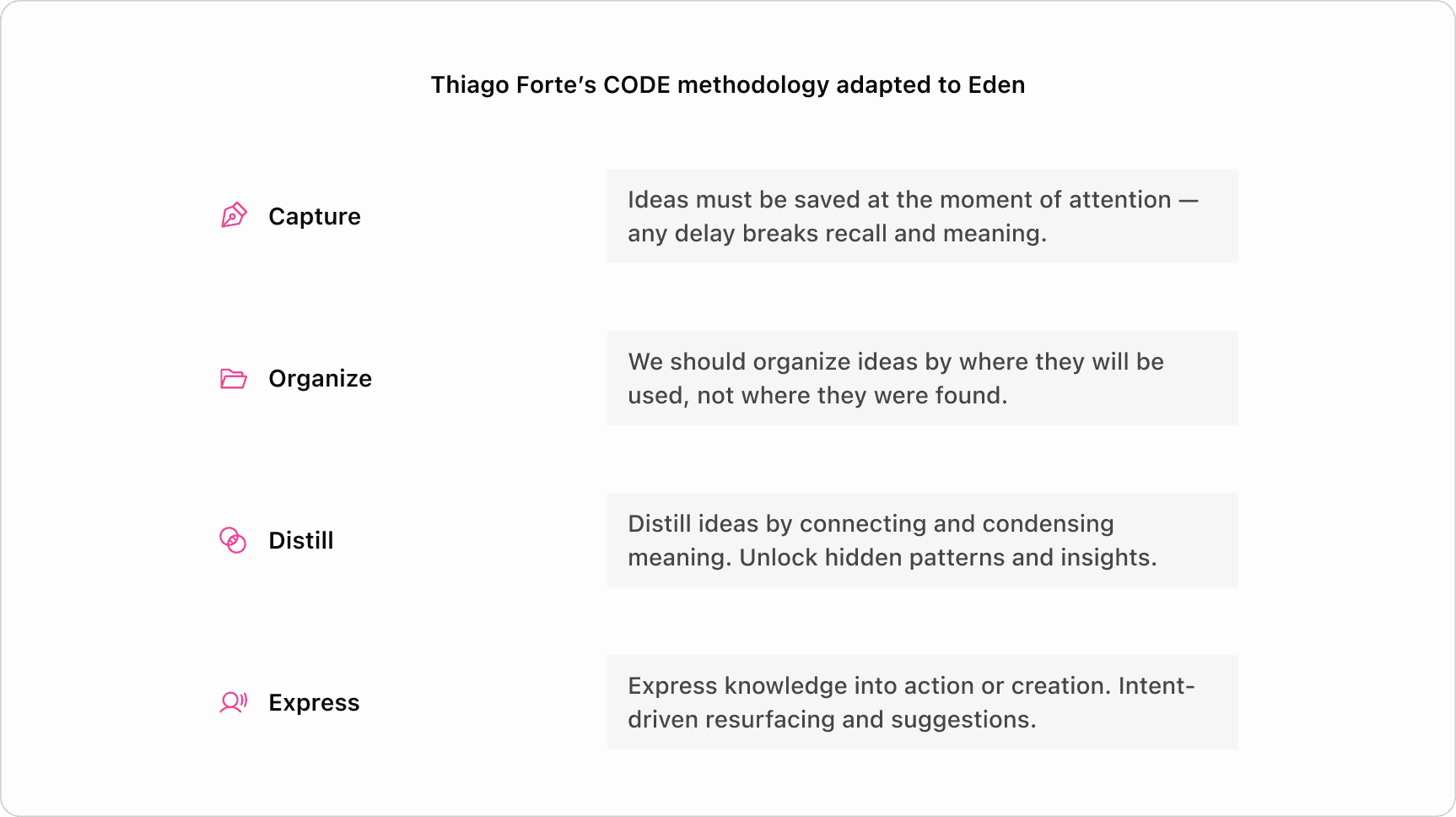
Eden is grounded in Tiago Forte’s second-brain methodology.
The digital second brain 🧠 should capture without friction, organize by intent, and resurface ideas when they’re cognitively relevant.
Iterations
1
Capturing ideas wasn’t easy.
High capture friction limited adoption, driven by excessive clicks (6/6 users) and missing visual triggers (4/6 users)
“Oh, in this version I can just save something and continue — I usually make a mental note to use that piece somewhere.”
V1 of idea capture
Iteration after user feedback
Frictionless capture of idea


2
AI features were overloading users.
Users didn’t need a chatbot or long answers — Eden should predict intent and surface relevant artifacts without requiring articulation.
Eden shifted from reactive chat to predictive AI — surfacing small, actionable suggestion pills, and feedback loops to continuously improve intent prediction.

What did I learn?
1
Designing for wisdom, not information
Eden was never about collecting more data. It was about moving users up the ladder — from data, to information, to knowledge, to wisdom.
Most tools stop at storage or retrieval; Eden treats those as intermediate states. The system’s responsibility is to understand information, connect it into knowledge, and surface wisdom at the moment it can influence action. Traversal should feel effortless; insight should feel intentional.
traverse on behalf of users
surface to users
Clear insights
Information
Knowledge
Wisdom
Data
screenshots
raw notes
links
Context
2
Letting the problem redefine itself
Eden changed shape because I refused to accept the first framing of the problem. What began as screenshots evolved into the ideas behind them, then into intent, then into behavior over time.
Each iteration came from reading between the lines—asking what users were really trying to do. The final solution wasn’t what I initially imagined, but it solved the original problem more deeply, while unlocking entirely new possibilities I hadn’t anticipated.
3
Articulation is a barrier
Create a to-do list
Draft email to
Book this flight
Eden is built on the belief that articulation is a barrier. People struggle to prompt their way into clarity; long conversations and explicit commands often get in the way of momentum.
Instead of demanding explanation, Eden searches on the user’s behalf—using context, behavior, and systems-level understanding to anticipate motive and suggest meaningful next steps. The intelligence stays in the background; the experience stays human.

You've reached the end, how about another read?